
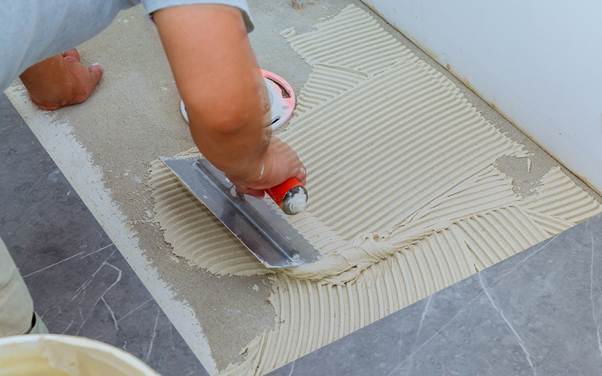
Choosing the right bonding material can have a major impact on your tiling project’s outcome. Whether tiling a bathroom floor or cladding an exterior wall, the choice between cementitious tile adhesive and tile glue affects everything from surface integrity to durability. While both products aim to secure tiles, they differ in formulation, application method, and performance across various conditions.
Here’s a closer look at the key differences—and how to decide which option suits your project best.
1. Understand the formulation and composition
The first thing to understand is the chemical differences between these products. Usually made of a dry mixture of cement, sand, and additives, cementitious tile adhesive is mixed with water before use. It forms a solid mechanical bond with surfaces after setting through hydration. Tile glue, on the other hand, is frequently a ready-mixed paste that is dried after being manufactured from acrylic compounds or polymer resins. Although tile glue is convenient, cement adhesives are more versatile and function better in settings.
2. Consider the surface type and tile size
Surface compatibility is crucial when selecting a bonding product. Cement adhesives perform well on rougher or uneven surfaces, such as concrete or cement screed, and accommodate heavier tile materials like porcelain or stone. Tile glue, while easy to apply, is better suited for smaller ceramic tiles on smooth indoor walls. If your tiles are large-format or will be installed on a floor, a cementitious tile adhesive will likely offer better hold and durability over time.
3. Evaluate water and heat resistance
For areas with high moisture exposure—such as bathrooms, kitchens, and outdoor spaces—cement adhesives are generally the preferred option. Once cured, they become highly resistant to water penetration and thermal stress. This makes them more reliable for wet areas or temperature-fluctuating environments. While tile glue can work in dry, indoor spaces, it tends to break down under prolonged moisture contact, limiting its use in high-humidity conditions.
4. Think about load-bearing requirements
Not all installations bear the same weight. For instance, a tiled floor or an exterior wall subjected to wind pressure will need stronger adhesion than a decorative backsplash. Cement-based adhesives provide higher bonding strength, making them suitable for heavy traffic areas and load-bearing applications. Tile glue, although user-friendly, may not offer the long-term strength required for demanding environments. For structural integrity, especially in commercial or exterior projects, cement adhesive is the safer choice.
READ MORE: How to Select the Right Tile Adhesive for Different Substrates
5. Assess ease of application and working time
Tile glue has its advantages, particularly in small-scale or DIY installations. It comes pre-mixed and ready to use, which reduces preparation time and ensures consistency in every batch. It also stays workable for longer, allowing easier adjustments during tile placement. Cementitious tile adhesive, by contrast, requires manual mixing and can set faster, which may demand quicker work and more experience. However, with the right team or training, cement adhesives provide greater control over installation depth and surface coverage.
6. Factor in drying and curing time
Curing time affects when the tiled surface can be walked on or grouted. Cement adhesives typically require a longer curing, especially in cooler or humid conditions. This delay is worthwhile for installations requiring high bonding strength. Tile glue generally dries faster, making it suitable for light-duty projects where speed is more important than long-term durability. For commercial jobs or surfaces that will bear significant loads, it’s worth allowing extra time for the cement adhesive to cure fully.
7. Weigh the long-term performance
Durability should always be part of the decision-making process. Cementitious adhesives are engineered for long-term performance, particularly in high-traffic or exterior spaces. They resist shrinkage, thermal expansion, and moisture-related issues when applied correctly. Tile glue, while sufficient for light-duty applications, can degrade over time in more challenging environments. If your goal is to avoid repairs or re-tiling in the near future, cement adhesives provide more peace of mind.
8. Match your choice to the project scale
Large renovation or commercial projects benefit from cementitious tile adhesive due to its cost-effectiveness, scalability, and strong performance. It’s the industry standard for most floor and wall applications in Singapore. Tile glue remains popular for quick fixes, decorative features, or small wall areas where minimal weight and exposure are expected. Selecting the right product for the scale and complexity of your work ensures fewer complications down the line.
9. Consider environmental and indoor air quality factors
For indoor installations, especially in homes or healthcare environments, low-VOC materials are increasingly preferred. Many cement adhesive products on the market now meet these standards, though tile glue may sometimes emit more odours during curing. Always check product certifications if this is a concern. Sustainability-minded projects can also look for eco-labelled adhesive options.
10. Consult with professionals when in doubt
Each tiling project has its own set of requirements. If you’re unsure which adhesive suits your job, consult with tiling professionals who can assess your surface conditions, usage needs, and local climate factors. Choosing the right bonding material upfront saves time, prevents tile failure, and ensures a longer-lasting finish.
Conclusion
Whether you choose cementitious tile adhesive for its strength or tile glue for its convenience, your decision should be based on the demands of the surface, space, and usage. Matching the product to the project ensures better results, fewer issues, and long-term performance. For expert advice and professional-grade adhesives, contact ARDEX – QUICSEAL SINGAPORE.